What's in a Name?
A story of symbols, sight, and the sublime act of understanding. A personal manifesto.
Poly = Many
Long before humanity had words, we had symbols. Primitive civilizations etched their knowledge into stone—ancestral records of hunts, migrations, cosmic events. These glyphs were humanity's first data storage system, a visual language transcending time and geography.
Polyglyph honors that ancient art. It represents the multiplicity of signals, the cacophony of information that surrounds me. Today, I swim in an ocean of data—terabytes cascading from every direction. Sensors, devices, platforms, and systems generate more information in a day than previous civilizations produced in centuries.
Analytica = The Big Picture
Analysis without synthesis is just noise. Anyone can gather data. The real challenge—the exquisite challenge—is knowing which symbols matter and how they relate. It's seeing the patterns hidden within complexity. It's asking not "what happened?" but "why? And what does it mean?"
Analytica is my commitment to depth. To moving beyond surface observations toward genuine insight. I love rabbit holes and can be lost inside them for months. In a world drowning in information yet starving for understanding, I seek the elegant truth beneath layers of bewildering complexity.
The Retrofitting Trap
Here's what I've learned: retrofitting new technology to old thinking is inherently limiting. It's like trying to run a highway through a medieval city—you can force it, but you'll never get the full potential. The technology bends to the constraints of outdated mental models. Some of the most ancient cities solved this problem by building flyovers.
When mobile arrived, businesses didn't just shrink their desktop websites. The ones that truly succeeded—they rethought everything. Mobile-first thinking unlocked capabilities no one expected. Design, speed, interaction—it all changed. That wasn't technology retrofitted to old thinking. That was new thinking from the ground up.
The Symbol Within the Sigil
The Magnifying Glass
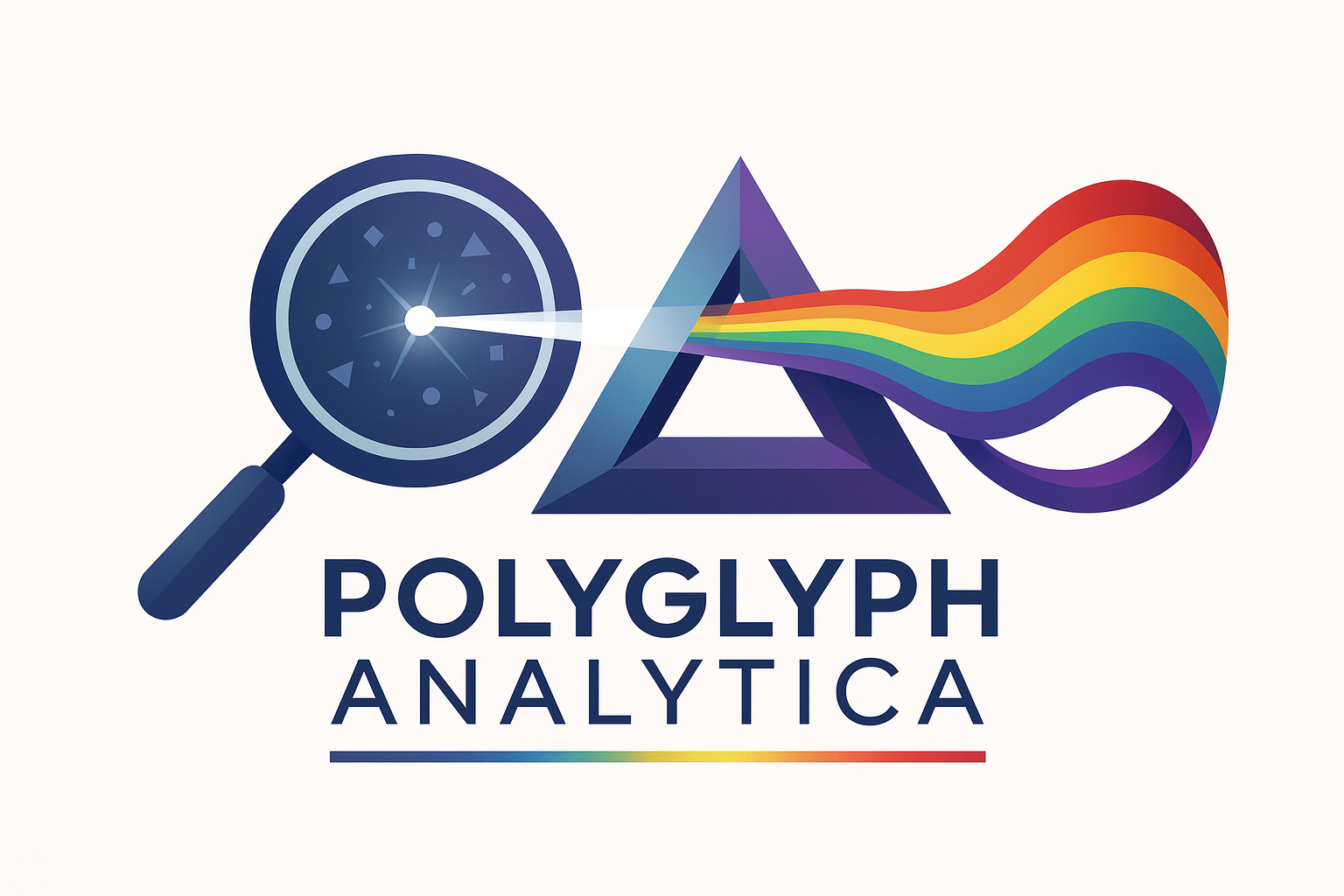
Polyglyph Analytica's logo is an example of how I love to play with ideas and concepts. Its defining element magnifies and concentrates. It represents the P in Polyglyph Analytica—the power of focused attention. In a world of infinite stimuli, focus is a superpower. It's the ability to isolate signal from noise, to illuminate what matters most.
The Prism
Suspended within that focus, the prism represents the A. Where light converges, understanding explodes. White light—seemingly simple, uniform—contains infinite possibility. The prism reveals it: a spectrum of colors, each with its own frequency, its own story.
One Person. The Right Tools.
There is no "we" at Polyglyph Analytica. There's me. One person. Having fun exploring. And that's not a limitation—it's the entire point. I am out to explore a frontier.
The old model required armies. You needed teams, committees, consensus. But that model was built on yesterday's constraints. Today, one person armed with the right tools—intelligent tools, AI-native tools—can think, build, and solve at a scale that previously required dozens.
Is it possible that one person could harness AI agents to surround oneself with skills we don't possess, and in doing so, build the organisation of the future?
Imagine light scattered chaotically, directionless. Then imagine a magnifying glass drawing those rays together—concentrated, purposeful. That focused beam encounters a prism, and suddenly, explosive possibility.
This is Polyglyph Analytica.
AI-First Thinking for AI-First Problems
I live at an inflection point. The problems that matter most—in finance, technology, and beyond—cannot be solved with yesterday's tools. They require a fundamentally different approach. Not replacing human intuition, but augmenting it. Not automating complexity away, but understanding it deeply.
My perspective is unapologetically AI-first. I don't ask: "How can AI help?" I ask: "What becomes possible when I think like machines and dream like humans?" That intersection is where the most interesting solutions emerge.
The pattern repeats across every major shift. When cloud arrived, companies that lifted-and-shifted old applications to cloud infrastructure watched their costs explode—they were still paying for always-on capacity, still thinking in terms of physical servers and static allocation. But those who thought cloud-native from day one? They unlocked something entirely different: zero-scaling idle capacity, then elasticity that balances demand spikes with cost. The old apps couldn't compete in the new paradigm. They were shackled by yesterday's constraints.
I'm keen to explore the frontier of AI-first thinking the same way. This isn't about bolting AI onto yesterday's approaches. It's about redesigning from the ground up, using AI as the lens through which I see problems and solutions.
Polyglyph Analytica.
Where many symbols converge into singular insight. Where complexity becomes clarity.